INITIAL ACTIVITIES LAUNCHED FOR THE INCLUSION OF THE PAINTED MOSQUE IN THE UNESCO TENTATIVE LIST
At the initiative of the National Conservation Centre and the Islamic Religious Community – Tetovo Mufti Office, and following a positive opinion issued by the National Council for Cultural Heritage, preparations have commenced for the inclusion of the “Religious Complex of the Painted Mosque” in Tetovo in the UNESCO Tentative List, as the first stage towards preparing a nomination dossier for inscription on the UNESCO World Heritage List.
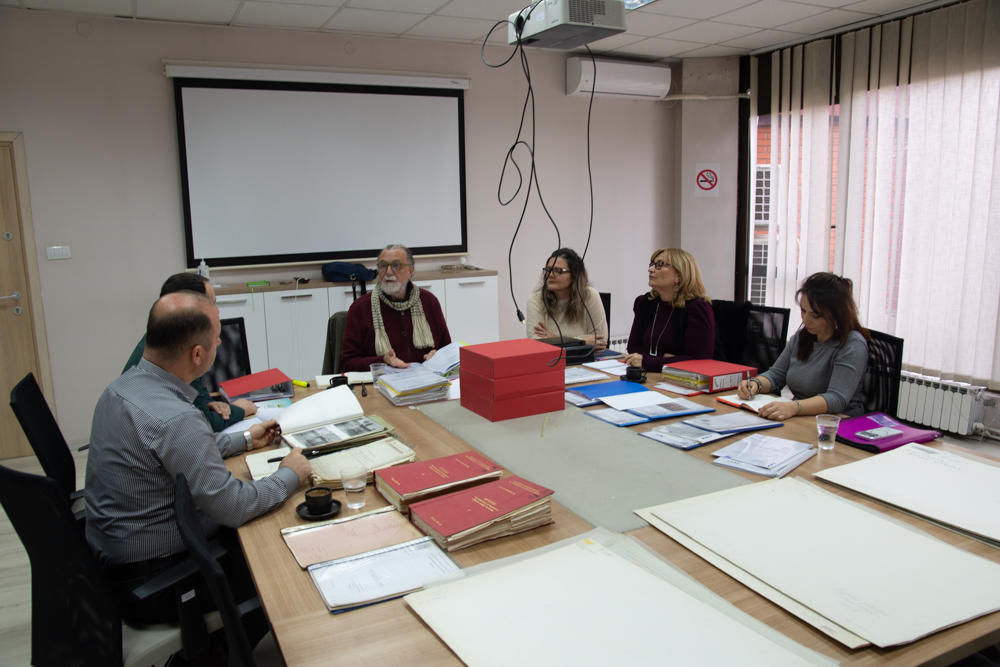
For this purpose, pursuant to a decision by the Minister of Culture and Tourism, Mr Sedat Sulejmani, a Working Group has been established, comprising: MA Zoran Pavlov, Art Historian, Senior Conservator and expert in Ottoman cultural heritage in Macedonia, serving as Coordinator; MA Cvetanka Hadji Pecova, Graduate Architect – Conservation Advisor; MA Afet Jashari, State Advisor for the Protection of Cultural Heritage at the Ministry of Culture and Tourism; Dr Mahmud Emini, representative of the Tetovo Mufti Office; as well as MA Luiza Nevzati, Graduate Architect – Senior Conservator, and MA Zarije Amdiu Rexhep, Conservation Advisor for Wall Painting at the National Conservation Centre.
In accordance with the Convention Concerning the Protection of the World Cultural and Natural Heritage and the Operational Guidelines for its Implementation, the Working Group has undertaken all the necessary stages with dedication, with the aim of preparing the required documentation for the nomination, so that this religious complex may attain the status it deserves in recognition of its outstanding architectural and artistic values.
The Painted Mosque in Tetovo is one of the most representative religious buildings of Islamic architecture erected in the 19th century in the territory of Macedonia. In addition to its rich geometric and floral ornamentation, particular attention is drawn to the presence of landscape motifs rendered in paintings of striking colourfulness. This is a rare example, demonstrating the influence of Western artistic expression, which penetrated deep into the territory of the Ottoman Empire. The paintings of the Painted Mosque represent a distinctive example of the synthesis of European Baroque and Rococo influences with traditional Ottoman aesthetics.
The religious complex is further complemented by an open-type türbe, located in the immediate vicinity of the mosque and erected no later than the first half of the 16th century. Its presence attests to the continuity of the complex’s existence over an extended period of time.
Prepared by: MA Zoran Pavlov, Senior Conservator for Ottoman Cultural Heritage
Photograph: Ljupcho Tanurovski, Documentalist